Tanker freight gained 44% in a week the S&P 500 lost 0.8%
For the four sessions through Friday, September 11, Amplify's tanker-freight fund BWET rose 43.9% as VLCC rates hit records; the S&P 500 fund SPY fell 0.8%.
Key takeaways
U.S. forces struck Iranian oil tankers in the Gulf of Oman. Iran answered against ships near the Strait of Hormuz. West Texas Intermediate crude then posted a second straight week near 9%, and the bill for moving that oil did not wait on the stock market.
Breakwave and the cost of a VLCC
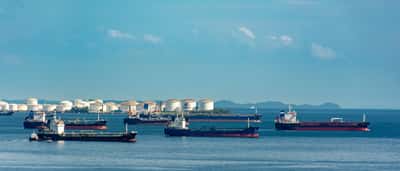
Amplify's fund of crude-tanker freight futures, BWET, rose 43.9%, to $726.92, from $505.17. It gained in every session, including 11.8% on Friday, when WTI fell 2.4%. Crude sold off as Gulf states moved toward talks with Iran on the Strait of Hormuz; the freight market kept paying. The fund does not own tanker companies and it does not own crude. About 90% of its freight futures are TD3C contracts on very large crude carriers from the Middle East Gulf to China, with a smaller slice on West Africa-to-Europe Suezmax routes. The ship rate is the war-risk price on that route, not a bet on the barrel.
Reuters put VLCC rates on the Gulf of Oman-to-China run at a record this week, about 450 on the Worldscale index, or roughly $11.50 a barrel, after what it called the biggest wave of attacks on shipping since the U.S.-Iran war began in late February. Houthis moving on Perim Island, at the Bab el-Mandeb strait, added a second chokepoint. BWET had already risen 18.5% the week before. It is up 3,674% year to date. The fund charges 3.50% and holds about $200 million, and nearly all of that freight book sits on one chokepoint route. Gulf foreign ministers plan to meet Iran on Monday in Oman. If those talks take the war-risk premium out of the Gulf-to-China rate, that is most of what the fund owns.
Oil futures were the same story in a slower wrapper. USCF's Brent fund, BNO, rose 9.4%. Invesco's oil fund, DBO, and USCF's WTI fund, USO, each rose 9.1%. Invesco's broader energy-futures fund, DBE, rose 8.2%. Brent itself went from $96.28 to $104.61; WTI from $91.48 to $100.05. The prior week, WTI had already climbed 9.7%, from $83.40. Two weeks, 20%.
Energy stocks did not come along. The Energy Select Sector fund, XLE, added 1.7%. Exxon Mobil, its largest holding, rose 4.1%; Chevron, 2.6%; ConocoPhillips, 2.3%. WTI's week was 9.4%. The producers moved. They did not move with the barrel.
The week's unleveraged board ran from tanker freight to uranium miners:
Freight was in another league from oil and uranium
Gasoline in the CPI, oil at $100
The Bureau of Labor Statistics reported Friday that August CPI rose 0.4% on the month and 3.4% on the year. Gasoline rose 3.9% in August and accounted for more than a third of the monthly increase. Energy rose 2.1% on the month and 16.3% on the year; gasoline was up 27.4% from a year earlier. Core prices, excluding food and energy, rose 0.3% on the month and 2.4% on the year.
That print is August. This week's $100 crude will show up later. The 10-year Treasury yield was 4.96% on Friday. The long Treasury fund, TLT, fell 1.6% and closed at $80.87, just above its 52-week low of $80.67. The gold fund, GLD, lost 2.0%. Simplify's commodities strategy fund, HARD, rose 6.6%, another way to hold the same oil move without a K-1.
AMD, Lumentum, and the other winners
Advanced Micro Devices rose 8.1%, to $516.13, after a 5.9% session on Tuesday. YieldMax's AMD option-income fund, AMDY, returned 7.1%, the rare covered-call product that kept most of a strong week in the underlying stock. Intel rose 7.5% on the week and 9.1% on Tuesday, the same session.
Roundhill's photonics and optics fund, LYTE, gained 6.6%. Almost all of it arrived Tuesday, when the fund jumped 8.2%. Lumentum, the largest equity holding, rose 11.0% that day and 5.2% on the week. Coherent added 8.3% for the week; Ciena, 8.9%. The fund opened on August 6. Four sessions is not a verdict on a theme that young, but the optical names did the work.
SanDisk, which led last week, fell 6.1% from Friday's close, to $1,633. That is a hangover, not a new story, and the 2x products that track it daily do not belong on this list.
Paladin and the uranium miners
Sprott's junior uranium fund, URNJ, fell 10.6%, the weakest unleveraged fund on the board. Paladin Energy, the largest holding, dropped 12.1%. Denison Mines fell 11.7%; Energy Fuels, 10.4%; Deep Yellow, 14.5%. Almost all of the damage landed Thursday and Friday. Cameco, the senior name that dominates Sprott's larger uranium-miners fund, URNM, fell 4.0%; that fund lost 8.2%. Spot uranium was $90 a pound, up 3.7% on the month.
What ordinary funds did
The S&P 500 fund, SPY, fell 0.8%. It dropped Tuesday through Thursday, then rose 0.85% on Friday after the CPI release, and still finished lower.
Every major allocation finished the week lower
That is the week most portfolios actually had: a modest leak in large-cap stocks, a worse one in small caps, and losses in Treasuries and gold, against a freight market at records and crude at $100. Next week the Federal Reserve meets with August gasoline already in the CPI and this week's oil price still ahead of it. The ranking that closed Friday is not subtle. The disruption paid the people who own the ship rate and the barrel. It paid the producers a fraction of that, and it was expensive for anyone who needed the 10-year yield to stay down.
U.S. cash sessions were closed Monday, September 7, for Labor Day, so the ranking covers four sessions, from Friday, September 4 through Friday, September 11. Inverse and leveraged products are excluded; a handful of daily-reset wrappers still printed on the raw board and are set aside here.
ETFs in this story
Frequently asked questions
What does the tanker-freight fund actually own?
It holds freight futures, about 90% TD3C contracts on very large crude carriers from the Middle East Gulf to China, with a smaller slice on West Africa-to-Europe Suezmax routes: not tanker stocks and not crude.
Why did freight keep rising when oil fell on Friday?
Crude sold off as Gulf states moved toward talks with Iran, but the ship rate is the war-risk price on the route, and the freight market kept paying.
Did the CPI report reflect $100 oil?
No: August CPI rose 0.4% on the month with gasoline more than a third of the increase, but this week's crude move shows up later.
What happened to uranium?
Junior uranium miners were the weakest unleveraged funds on the board, down about 11%, with most of the damage on Thursday and Friday, even as spot uranium sat at $90 a pound.