BlackRock's new robotics ETF joins funds that size the same suppliers differently
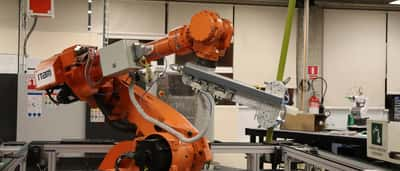
A record 603,307 industrial robots went into factories last year, and about 7,000 full-size humanoids were sold worldwide for commercial and professional use.

Key takeaways
BlackRock launched the iShares Future Robotics and Related Technologies Active ETF RBTX on Tuesday, Oct. 20, and announced it on Wednesday, Oct. 21. The fund page showed $10 million in net assets, 400,000 shares and a $25 net asset value as of Tuesday. The fee is 0.65%.
BlackRock said RBTX seeks to maximize total return by investing in companies across the robotics value chain, including those that develop, support, supply, service, enable or implement the automation of physical tasks with intelligent machines.
Tony Kim and Reid Menge of BlackRock's Fundamental Equities Technology Team will run it. BlackRock said that team oversees more than $50 billion in artificial-intelligence and technology strategies as of Sept. 30, 2026.
The performance benchmark is the MSCI ACWI Net index, a world-stock gauge. There is no performance record yet.
The robotics funds already on the market hold many of the same suppliers. They do not hold them at the same size.
A record year for the robots already at work
The International Federation of Robotics said on Sept. 24 that factories installed 603,307 industrial robots in 2025, up 11%, a record after four years around 550,000 a year. The number of robots operating reached a record 5 million, up 9%.
China took 354,000 of those installations, up 20%, and 59% of the world total.
On Sept. 30, the federation said about 7,000 full-size humanoids, taller than 140 centimeters, were sold worldwide in 2025 for commercial and professional use, beyond research and entertainment. Safety standards, the cost of training and maintenance, and the lack of a strong business case, particularly in industrial settings, still limit wider use, the federation said.
Same names, different sizes
The Global X Robotics & Artificial Intelligence ETF BOTZ tracks the Indxx Global Robotics & Artificial Intelligence Thematic Index. Global X says the fund seeks companies that potentially stand to benefit from increased adoption of robotics and artificial intelligence, including industrial robotics and automation, non-industrial robots and autonomous vehicles. It reported $3.34 billion as of Oct. 9 and charges 0.68%.
In Global X's latest holdings, the five largest positions were Intuitive Surgical at 9.08%, Fanuc at 8.42%, Keyence at 8.18%, Nvidia at 7.96% and ABB at 7.95%. The 10 largest added up to 57.5% of the fund.
Intuitive Surgical makes surgical robots. Fanuc, Keyence and ABB make factory equipment and the sensors that run it. Nvidia makes the chips.
The ROBO Global Robotics and Automation Index ETF ROBO holds a wider list than BOTZ. It launched Oct. 21, 2013, reported $2.02 billion as of Sept. 30 and charges 0.95%.
Its fact sheet lists 79 stocks, rebalanced quarterly. In the holdings file compared with BOTZ, the largest position is Intuitive Surgical at 2.17%, and the 10 largest are 17.1% of the fund.
The two files share 28 stocks. Intuitive Surgical is 4.2 times the weight in BOTZ that it is in ROBO. Fanuc is 8.42% against 1.81%, Keyence 8.18% against 1.54%, and ABB 7.95% against 1.37%.
Same four suppliers, different weights
- BOTZ
- ROBO
- Intuitive
- BOTZ 9.1%
- ROBO 2.2%
- Fanuc
- BOTZ 8.4%
- ROBO 1.8%
- Keyence
- BOTZ 8.2%
- ROBO 1.5%
- ABB
- BOTZ 7.9%
- ROBO 1.4%
Add each of those 28 stocks at the smaller of the two weights, and the total is 28.8% of assets. The names overlap. The sizing does not.
The VanEck Robotics ETF IBOT is smaller and cheaper. It launched April 5, 2023, reported $102 million as of Sept. 30 and charges 0.47%. VanEck says it tracks the BlueStar Robotics Index, intended to track the performance of companies involved in robotics. On that date Keyence and Nvidia were tied at 5.64%, the 10 largest were 41.1% of the fund, and the list included ASML, which makes the machines that make chips, at 5.14%, and TechnipFMC, an energy-services company, at 2.28%.
The ARK Autonomous Technology & Robotics ETF ARKQ does not track an index. It charges 0.75%.
In ARK's holdings file for Oct. 9, Tesla was 11.0% and Space Exploration Technologies, the corporate name of SpaceX, was 8.9%. The Class A shares trade on Nasdaq. Nvidia, Teradyne, Palantir and Kratos, a defense contractor, followed.
On Global X's Aug. 31 fact sheet, 18.5% of BOTZ's equity positions were in China, against 32.9% in the United States and 30.2% in Japan. That is well short of China's 59% of 2025 installations. VanEck's Sept. 30 fact sheet put 41.9% of IBOT in the United States and 23.7% in Japan, and China was not among that fund's 10 largest country weights, which together were 95.6% of assets.
The prices have not moved together
Two funds launched last June aim at humanoid robots rather than the factory suppliers above. Roundhill Investments' Roundhill Humanoid Robotics ETF HUMN started June 26, 2025. The KraneShares Global Humanoid Robotics and Physical AI Index ETF KOID started June 4, 2025.
From the last close of 2025 through Tuesday, Oct. 20:
On the same basis, State Street's SPDR S&P 500 ETF Trust SPY rose 12.8% and the Invesco QQQ Trust QQQ rose 16.8%. IBOT beat both. BOTZ trailed SPY by 20.1 percentage points and trailed IBOT by 26.7 percentage points.
As of Sept. 30, 2026, Global X reported a five-year annualized net-asset-value return of -0.47% for BOTZ.
Humanoid funds are ahead of the shipments
HUMN is actively managed. It reported $91.8 million as of Sept. 30 and charges 0.75%.
As of Oct. 15, the largest line was a Treasury bill due Dec. 3, at 11.7% of the fund. The next was a swap on Yushu Technology, at 8.17%, not the Shanghai shares. Tesla and Harmonic Drive Systems were still in the holdings.
Yushu Technology, known as Unitree, makes humanoid and four-legged robots in China, and its shares began trading in Shanghai on Aug. 19. On Roundhill's Sept. 30 fact sheet, Yushu was already the largest holding, at 6.04%, ahead of Tesla at 5.75%, Harmonic Drive Systems at 5.71% and UBTech Robotics at 4.30%.
KOID reported $342 million as of Sept. 30. KraneShares lists a 0.79% gross expense ratio and a 0.69% net expense ratio. The fund tracks the MerQube Global Humanoid Robotics and Physical AI Index, which KraneShares says consists of companies engaged in humanoid and embodied intelligence-related business.
In the latest holdings file, the largest position was Hexagon, a measurement and software company, at 2.3%. The Sept. 30 fact sheet put 40.7% of the fund in the United States and 22.8% in China.
The BBC reported on Aug. 19 that Unitree shipped more than 5,500 humanoid robots in 2025. The federation's count of full-size machines sold worldwide that year was about 7,000.
Want more of our stories in Google’s Top Stories? Add etf.net as a preferred source on Google