Iran claims a Hormuz tanker strike as Brent falls to $103
Iran's Revolutionary Guards said Friday, September 18, 2026 they struck the Togo-flagged tanker Trend in the Strait of Hormuz; Brent overnight futures traded at $103.44, down 1.3%.
Key takeaways
Iran's Islamic Revolutionary Guard Corps Navy said Friday it had struck the Togo-flagged oil-products tanker Trend in the Strait of Hormuz on Thursday night and brought the ship to a halt after a fire. The statement has traveled farther than any confirmed barrel.
The ship's manager has not spoken, no charterer has been named, and the U.S. military has not commented. The United Kingdom Maritime Trade Operations office reported a security incident on Thursday 16 nautical miles northeast of Khasab, Oman, and did not name a vessel. For anyone holding crude, energy stocks, or tanker freight, that still means little, yet: the choke point is already priced as choked.
Hormuz traffic had already collapsed
Brent last traded at $103.44 a barrel as of about 2 a.m. Eastern Friday, down $1.38, or 1.3%, from Thursday's $104.82 settlement. Reuters attributed that third session of losses to hopes of alternate routes for Middle East barrels. West Texas Intermediate, in the same overnight session, traded at $96.30, down $5.61, or 5.5%, from Thursday's $101.91 settlement. U.S. cash markets have not opened on either print.
Ship-tracking figures put transits through the strait on Wednesday, September 16, at three, down from 12 the previous day and against a 10-day average of about 17. The U.S. Energy Information Administration estimated that crude and petroleum liquids through Hormuz averaged 4.9 million barrels a day in the second quarter, down 77% from 21.6 million in the fourth quarter of 2025.
Saudi Arabia shut the East-West crude pipeline on Friday, September 11, after drone strikes on September 10 and 11, boxing in a bypass around Hormuz that the kingdom had been using. Tehran has been attaching its name to ships for days. Last week the IRGC said it had attacked two U.S. vessels, eight oil tankers, and 10 "non-compliant" ships; U.S. Central Command said no U.S. Navy warship was hit. On Monday the Guards said the Panama-flagged tanker El Gaia had hit Iranian sea mines; CENTCOM called that account false.
Trend is 7,119 deadweight tons
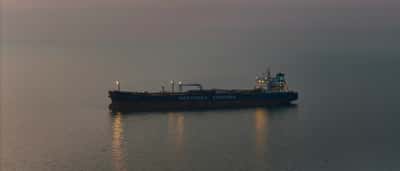
Trend, IMO 9477177, is an 18-year-old oil-products tanker flying the Togolese flag: 118 meters long, 7,119 deadweight tons. That is a coastal-scale products hull, not a crude carrier whose cargo would move a global balance.
The IRGC Navy said the ship had attempted an "illegal passage" after being "deceived" by the U.S. military, that it "was struck and stopped after a fire broke out," and that unauthorized transit "will achieve nothing other than the destruction of the offending vessel." It said its forces still held the strait. It offered no cargo, crew, injury, or afloat-status details. Public tracking last had Trend arriving at Sharjah Anchorage, inside the Persian Gulf, on Tuesday, September 15, after a sailing from Khor Al Zubair, Iraq. Some registries listed Fujairah, on the Gulf of Oman side of the strait, as the next destination.
War-risk cover was already expensive on the quotes that are public. In July, Marsh put additional Hormuz hull premiums at 7.5% to 10% of hull value, up from 1% to 3% weeks earlier. In early September, ENOC director Paul Bradshaw told the APPEC conference that cargo insurance had reached 5% to 6% of cargo value, potentially another $10 million, and that additional war-risk on cargo had gone from effectively zero to as much as 10% of cargo value. Combined, he put the cost of a Hormuz transit at $10 million to $20 million.
Crude and tanker funds still sit on Thursday's close
Thursday's U.S. close is the last print holders have. It does not include Friday's claim.
Near-dated WTI futures via United States Oil Fund USO, graded B in etf.net's Energy Futures category, closed Thursday at $155.31, down 0.55%. Near-dated Brent futures via United States Brent Oil Fund BNO, graded C in the same group, fell 1.3%. S&P 500 energy stocks via Energy Select Sector SPDR XLE, graded A among broad energy funds, rose 0.70%; the fund is Exxon Mobil at 20% and Chevron at 15%, with the rest in large U.S. producers, refiners, and oilfield names. None of those funds is a Hormuz tanker.
Tanker freight via Breakwave Tanker Shipping ETF BWET, Amplify's fund graded D in Energy Futures, is the sleeve that prices the waterway. About 46% of the fund sits in TD3C freight futures on the Middle East Gulf-to-China crude run. Shares closed Thursday at $786, barely changed on the day, up 21% over five sessions and 3,981% this year from $19.26 at the end of 2025. That fund was still rising on Wednesday as crude fell.
Freight kept climbing as crude peaked and faded
- BWET · 786
- USO · 155.31
The larger number on the board is already there: West Texas Intermediate, down 5.5% overnight. Trend is 7,119 deadweight tons.
ETFs in this story
Frequently asked questions
Has anyone confirmed the strike?
No: the ship's manager, the charterer and the U.S. military have all stayed silent, and the UK maritime office logged an incident near Khasab without naming a vessel.
Why didn't oil prices jump?
Brent fell 1.3% overnight in a third session of losses on hopes of alternate routes for Middle East barrels, and WTI was down 5.5%.
How much traffic is still moving through Hormuz?
Ship-tracking counted three transits mid-week, against a 10-day average of about 17.
Which fund actually tracks the waterway?
Breakwave Tanker Shipping holds about 46% in TD3C freight futures on the Middle East Gulf-to-China crude run, and it's up 21% over five sessions.